Sunday, June 20, 2010

Stephen Meyer Explains Intelligent Design Creationism

 
Here's Stephen Meyer on The 700 Club explaining why Intelligent Design Creationism is likely to be true. This is about as good an explanation as you're ever going to get.


Keep in mind that Intelligent Design Creationism is a strictly scientific theory. It is not religious. It just so happens that an evangelical Christian television show has an audience that's very interested in science.


PZ's Radical Tree of Life

 
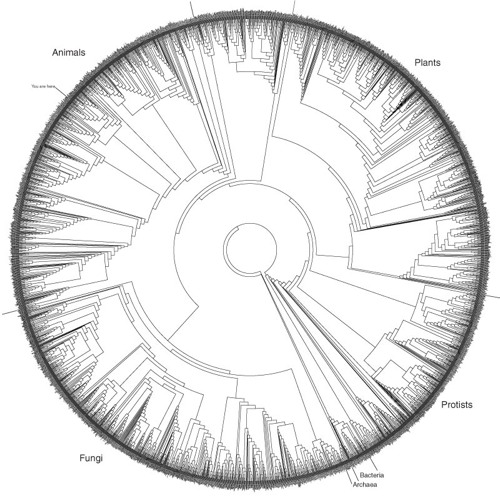
Check out PZ Myer's "radical" tree of life [Radial tree of life].


Why is this tree "radical"1? Because it completely misrepresents the relative importance of animals. Bacteria are relegated to insignificant status when, in fact, the diversity among bacteria is every bit as great as the diversity within eukarotes. Protists are grossly underrepresented as well.

This is a tree for those people who think that humans and other animals should be much more important than they are. One word for that is "radical" but I can think of many others. I'm surprised at PZ for using this tree. That's not at all like him.


1. PZ says it's a "radial" tree, not a "radical" tree.

[Tree Source: David M. Hillis, Derrick Zwickl, and Robin Gutell, University of Texas]

Thursday, June 17, 2010

AAAS Supports Accommodationism, Illogically

 
Alan I. Leshner is the CEO of the American Association for the Advancement of Science (AAAS) and Executive Publisher of Science. He has written an article for the Huffington Post [Science, Religion and Civil Dialogue]. As usual, this type of accommodationist focuses on the fact that there are religious scientists. In this case, the recent study by Elaine Ecklund gets a prominent mention.
Let's hope that Ecklund's unusually comprehensive assessment will help overturn the myth that scientists reject spirituality, or that science and religion are inherently incompatible.

That myth persists among scientists and religious believers alike. In 2009 study by the Pew Research Center, 61% of Americans said that science poses no conflict with their own faith. Nonetheless, 55% of those same respondents said they view religion and science generally as "often in conflict." Evolution, for instance, has divided Americans since 1859, when Charles Darwin published "On the Origin of Species."

There is a better way, which will be demonstrated June 16 when leading scientists and a respected Christian minister engage in a free, public dialogue at the American Association for the Advancement of Science (AAAS).
There may be a myth that all scientists reject spirituality. I really can't comment on that except to note that I have never, ever, heard anyone make this claim.

The real issue is whether science and religion are inherently incompatible and that issue is not a "myth" by any stretch of the imagination. It's a perfectly reasonable position, whether you agree with it or not. The existence of scientists who are religious does nothing to decide the issue one way or another. After all, there are scientists who believe in homeopathy but that doesn't mean homeopathy is compatible with science. What Leshner says is illogical and logic is supposed to be one of the hallmarks of good science.1

If the CEO of AAAS can't distinguish real philosophical issues from "myth" then I suggest that Americans need a new CEO—one who will keep the organization out of domains where it has no mandate to speak for all scientists. If Alan I. Leshner can't keep religion out of the organization then he should resign.2

As you might expect, Jerry Coyne restates the position that many of us hold [The AAAS goes all accommodationist]. Scientific organizations like AAAS have no business making claims about whether science and religion are compatible or not. When they cow-tow to religion they are separating themselves from a great many scientists who hold contrary points of view. The organization does not, cannot, and should not speak for scientists on subjects outside of science.

What Should Scientific Organizations Say about Religion?

How Should Scientific Societies Treat Religion?

Are Science and Religion Compatible? AAAS Says Yes.

AAAS Panel: Communicating Science in a Religious America


1. I haven't mentioned the other illogical part of the argument; namely, that criticism of religion is "uncivil."

2. Please, let's not have any silly debate over whether Leshner is expressing a personal opinion or speaking for AAAS. Read his article and note how he identifies himself as author.

Wednesday, June 16, 2010

Richard Dawkins Talks About the Human Genome

 
Richard Dawkins is hosting a four part series on the human genome to be broadcast on BBC radio [The Age of the Genome]. Here's part of the summary for episode 1.
In spite of the advances, there have been some surprises and deepened mysteries. One of the greatest shocks was the finding that we have far fewer genes than scientists had assumed before they read out our genetic instructions. It takes no more genes to make a person than it does to make a simple microscopic worm. What makes a man different from a worm lies more in what researchers now calling the Dark Matter of the genome - 300 million letters of genetic code which work in currently mysterious ways.

Richard Dawkins is an evolutionary biologist at Oxford University and the author of numerous books on evolution and genetics such as 'The Selfish Gene'. In interviews with scientists who led the initial effort to decode the genome and those who are now at the forefront of genetic research, Richard brings his evolutionary insights and fascination with the universal genetic code of life to illuminate how far we've come, and where we are heading in the Age of the Genome.
Note to Richard,

Many scientists, including the experts in the subject, expected there to be about 30,000 genes in our genome. They were pretty close to being right. No surprises there.

What makes a man different from a worm is that we have a smallish number of different genes and the genes we have in common are regulated differently. This conclusion comes from studies in developmental biology that were completed before the Human Genome Project began. Differences in regulating gene expression can be easily accomplished by changing a few base pairs in the promoter/enhancer region of the gene. No mystery there. The field is called evolutionary developmental biology and it's based on an understanding of evolution.

The "dark matter" is junk. The sequence of the human genome goes a long way toward proving what was suspected back in 1970. That's not a surprise. It's a prediction confirmed. Everything we know about the evolution of genomes in diverse species is consistent with the idea that much of our genome has no function. Evolution explains pseudogenes, it explains the so-called C-value paradox, it explains transposons and selfish DNA, it explains highly repetitive sequences. The "dark matter" has been exposed to the light of day and it looks like junk.


Eleventh International Congress of Demotic Studies

Eleventh International Congress of Demotic Studies, Oxford, 30 August – 3 September, 2011

Second Announcement

For the dates of the Congress please see above. This will take place in Merton College. It is planned to make the Congress a residential one, so that participants will actually be able to stay in the college (both en-suite and standard rooms will be available). Oxford is a very popular tourist destination, especially around the time when the Congress will take place. Hotel accommodation is limited, especially in and near the city centre, and tends to be quite expensive, so although staying in the college is not mandatory, most participants should find that there is a savings to be made by doing so. At this time I would be grateful if you could answer the questions below and return this form to me so that I can obtain a rough idea of the number of those who are likely to attend. Please note that answering yes to any of these questions does not constitute a commitment on your part.


1) I am interested in attending the Eleventh International Congress of Demotic Studies. (yes/no)

2) I am interested in presenting a paper at the Congress. (yes/no)

3) I am interested in booking accommodation at Merton College. (yes/no)


                                                                                         Mark Smith

                                   
                                                                                                   8/6/2010

Tuesday, June 15, 2010

False History and the Number of Genes

Mihaela Pertea and Steven L Salzberg have just published a paper in Genome Biology with an interesting title: Between a chicken and a grape: estimating the number of human genes. Part of their paper covers the history of gene number estimates and it includes the figure shown here.
Figure 2. The trend of human gene number counts together with human genome-related milestones. Individual estimates of the human gene count are shown as blue diamonds. The range of estimates at different times is shown by the two vertical blue dotted lines. Note how this range has narrowed in recent years.
This is really annoying because it perpetuates a myth that needs to be debunked. I've addressed it in an earlier posting [Facts and Myths Concerning the Historical Estimates of the Number of Genes in the Human Genome].

Mihaela Pertea and Steven L Salzberg have completely ignored a substantial literature on the subject. First, there's the genetic load arguments of King and Jukes from 1969. They estimated that there had to be fewer that 40,000 genes in our genome. Ohno summarized the estimates in a 1972 paper and came up with an estimate based on current knowledge of 30,000 genes (Ohno 1972).

Then there's the substantive literature on expressed sequences from the 1970's These were mostly hybridization experiments showing that human tissues had a core of about 10,000 genes expressed in the most complex tissues. The estimate was that there were probably no more than double that number of genes in total. Benjamin Lewin was the expert on this subject and his early books (especially Gene Expression II) covered all the bases. By 1983, Lewin was able to conclude in Genes II ...
Given some uncertainties about estimating the numbers of genes present in multiple copies, we might say that the mammalian genome looks to be of the order of 30,000 - 40,000 gene functions.
He published the same estimate in Genes IV in 1990.

Lewin was not alone. Most textbooks contained similar estimates in the 1980s. In Molecular Biology of the Cell by Alberts et al. (1983) the estimate was also 30,000 genes (p. 406). These estimates were not dismissed as unreliable. Quite the contrary. In my circles, the general impression was that humans had to have fewer than 50,000 genes and the number was likely to be less than 30,000.

It's true that Walter Gilbert had "guesstimated" 100,000 genes and it's true that the early estimates from the Human Genome Project used a number like this (based on a false assumption). But that doesn't mean that everyone agreed. Indeed, among those who had really studied the problem, a much lower number was preferred.

During the 1990s, the preliminary results from EST cloning and sequencing started to come in and it looked like there were at least 100,000 genes based on this data. However, this was a controversial estimate precisely because so many people knew that it conflicted with a lot of data. Sure, there were those who believed the EST data over everything else but they did not represent everyone who was interested in gene numbers. It is very misleading to suggest that there was a consensus in favor of more than 50,000 genes as the figure implies.

That's false history and it does a great disservice to those who turned out to be correct.


[HatTip: Carl Zimmer]

King,J.L. and Jukes,T.H. (1969) Non-Darwinian evolution. Science 164; 788-798.

Ohno, S. (1972) So much "junk" in our genome. Brookhaven Symp. Biol. 23:366-310.

Monday, June 14, 2010

G. BASTIANINI - A. CASANOVA, I PAPIRI DEL ROMANZO ANTICO

I PAPIRI DEL ROMANZO ANTICO
Atti del Convegno Internazionale di Studi
Firenze, 11-12 giugno 2009

a cura di Guido Bastianini e Angelo Casanova
Firenze, Istituto Papirologico "G. Vitelli" 2010
(Studi e Testi di Papirologia, N.S. 12)
pp. 290 + XVI tavv.
ISBN 978 88 87829 43 3
euro 60
distribuzione:

CASALINI LIBRI
via Benedetto da Maiano 3, I-50014 Fiesole (FI)
 tel. 0039 055 50181
fax 0039 055 5018201


Sommario:

Premessa (G. Bastianini - A. Casanova), pp. V-VI
Lectori salutem (C. Austin), p. 1

G. Messeri, I papiri di narrativa dal 1893 a oggi, pp. 3-41


P. Parsons, Panionis and the culture of Culture (P.Oxy. LXXI 4811), pp. 43-49


G. Zanetto, P.Oxy. LXX 4762 e il romanzo dell'asino, pp. 51-63


A. Henrichs, Fractured Communications: Narrators, Narratives and Discourse in Greek Novels on Papyrus, pp. 65-80


R. Pintaudi - L. Canfora, PSI Laur. inv. 22013: retorica o romanzo?,  pp. 81-93


M.P. Lopez Martinez, New contribution to some papyri labelled as incerta in a corpus of novel fragments, pp. 95-119


A. Casanova, Ambienti e luoghi nei frammenti di Lolliano, pp.121-137


F. Conca, Il Codex Thebanus e i papiri: suggestioni sul testo di Caritone, pp. 123-152


A. Guida, Caritone in Vaticana, pp. 153-163


A. Stramaglia, Le Metamorfosi di Apuleio tra iconografia e papiri, pp. 165-192


A. Billaut, Le roman de Sésonchosis: fragments, thèmes et fiction, pp. 193-205


L. Giuliano, PSI XII 1285 e le lettere del ciclo di Alessandro, pp. 207-222


R. Hunter, Rhythmical language and poetic citation in Greek narrative texts, pp. 223-245


L. Del Corso, Il romanzo greco a Ossirinco e i suoi lettori, pp. 247-277


G. Bastianini, PSI XIII 1305, Romanzo di Nino, pp. 279-288


Thanks to Prof. Bastianini for sharing the table of contents with me.