Tuesday, July 3, 2007

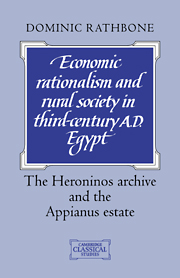
PAPERBACK release: D. RATHBONE, Economic Rationalism and Rural Society in Third-Century AD Egypt


Economic Rationalism and Rural Society in Third-Century AD Egypt
The Heroninos Archive and the Appianus Estate
Series: Cambridge Classical Studies

Dominic Rathbone
King's College London
Paperback

(ISBN-13: 9780521037631)
Also available in Hardback
For price and ordering options, inspection copy requests, and reading lists please select:
Europe, Middle East and Africa | Americas | Asia | Australia and New Zealand
This book reconstructs the life and workings of the Appianus estate in the Fayum district of Egypt under Roman rule in the third century AD. Basing his study on the extensive documentary evidence of the Heroninos archive, consisting of hundreds of letters and accounts on papyrus, Dr Rathbone examines first the nature of rural society at the time, and in particular the status of estate owners, their relations with their upper-class managers and the social and economic position of the estate’s workforce and outside contacts. He then looks at the organization and running of the estate, the production and marketing of its crops and centrally directed transport system, and, above all, its use of credit arrangements and its system of accounting. This was one of the most sophisticated yet known in the ancient world and the author uses this example of economic rationalism to challenge the common belief that economic thought and practice were uniformly ‘primitive’ in the ancient world. Appendices include an index of all the published texts of the Heroninos archive, and two of Heroninos’ accounts with an English translation.

• Growing interest in Roman Egypt • Valuable presentation of papyrus records • Much more saleable than is immediately suggested by the title

Contents

List of figures and map; List of tables; Preface; List of abbreviations and notes for the reader; 1. The archive and the estate; 2. Owners and managers; 3. Permanent labour; 4. Occasional labour; 5. Lessees and other contractors; 6. Production on the phrontides; 7. Transport, marketing and monetisation; 8. The accounts; 9. Conclusions; Appendix I. Papyrological matters; Appendix II. Measures and prices of wheat and of wine; Indexes.

Sammelbuch XXVII 1, Index 1 zu SB XXVI

Sammelbuch griech. Urkunden, XXVII 1, Index Teil 1 zu SB XXVI.
Verlag Harrassowitz Wiesbaden, 2007.
ISBN 978-3-447-05597-0.
Ladenpreis 22,- Euro.


Soure: Papy-l

REVIEW of Victoria C. Gardner Coates, Jon L. Seydl, Antiquity Recovered. The Legacy of Pompeii and Herculaneum

Bryn Mawr Classical Review 2007.06.48
Victoria C. Gardner Coates, Jon L. Seydl, Antiquity Recovered. The Legacy of Pompeii and Herculaneum. Los Angeles: J. Paul Getty Museum, 2007. Pp. 304; figs. 121. ISBN 978-0-89236-872-3. $60.00.


Reviewed by Eric M. Moormann, Radboud Universiteit Nijmegen (e.moormann@let.ru.nl)
Word count: 2374 words

below is the part of the review dealing with the Herculaneum papyri

James Porter contributes a paper on the discovery of ancient texts in the Villa of the Papyri at Herculaneum. No new text of Aeschylus, Homer or Livy or any other major author was discovered among the carbonised scrolls. He sketches how eagerly scholars dismissed the importance of the texts by Philodemus, which are interesting in their own right. Porter presents a sound debunking of the romantic vision of the villa as a philosophical retreat, e.g. of Calpurnius Piso, with Philodemus as the pet philosopher. We cannot deduce that from the facts. Even the 'library' was nothing but crates and heaps of papyri found in disorder. Porter rides his hobbyhorse in stressing the problem of classicism (or not) in these texts and concludes that the readers of these texts were strongly deluded by Antiquity, which offered a different face than they wished.2 He refers to suggestions of new excavations to find more texts and apparently does not know of the dig made in the 1990s at the behest of the then director of the Papyrological Institute at Naples, Marcello Gigante. More or less unpublished, offering almost nothing to either archaeologist or tourist, these new ruins at the northern side of excavated Herculaneum are decaying rapidly.3 All these disappointments, however, did not prevent literary reactions: the number of literary texts "found at Herculaneum" increased incredibly in the run of the 18th century. I mention only the pamphlet cited supra and the Voyages d'Antenor en Grèce et en Asie, presumably translated from a Greek manuscript from Herculaneum by E.-F. Lanthier in 1795.

read the whole review here

Monday, July 2, 2007

Gene Genie #10

 
Gene Genie #10 was posted Ryan Gregory on Genomicron [Gene Genie #10 -- The Canada Day Ultraspectacular Edition].

Visible Mutations and Evolution by Natural Selection

 
A recent posting [Darwin Still Rules, but Some Biologists Dream of a Paradigm Shift] raised the issue of adaptationism. The controversy is over the main mechanism of genetic change in evolving populations. Adaptationists tend to attribute as much as possible to natural selection while pluralists emphasize the important role of other mechanisms of evolution, like random genetic drift.

There seems to be little doubt that most of the fixed alleles at the molecular level are probably neutral in their effect. Thus, they have been fixed by random genetic drift. This includes many amino acid substitutions in proteins. Even though these substitutions change the structure of a protein by a small amount, it does not seem reasonable to assume that they have all been selected.

Most adaptationists are content to concede this point (although there are holdouts). However, they draw the line at more "visible" mutations. According to this group, the vast majority of "visible" mutations are subject to natural selection and therefore most fixed alleles with a "visible" phenotype are adaptations. The argument seems to be that once a mutation produces a "visible" phenotype then it is not appropriate to suggest that it might be neutral with respect to natural selection. The line seems to be drawn somewhere above differences in the amino acid composition of proteins but it's not clear exactly where.

p-ter is one of those who are very reluctant to admit that a visible character could have been fixed by accident. He has posted a short article on Gene Expression [Do phenotypes evolve neutrally?]. I recommend that you read the comments to see examples of the extreme version of adaptationism. Most of these adaptationists will even argue that human blood types are adaptive. The idea that most native North Americans have type O blood is due to some undefined selective advantage and not to accident.

This argument has been going on for several decades. As usual, it's not about the existence of natural selection or random genetic drift. It's about their relative importance in evolution. To reiterate, the adaptationists believe that almost all mutations with a visible phenotype have been fixed by natural selection. The pluralists think that many of them are neutral and have been fixed by accident. The adaptationists make a distinction between what happens at the molecular level and what happens at the "visible" level while the pluralists think the same mechanims are operating at both levels.

Richard Lewontin uses the example of the Indian and African rhinoceros to focus the debate. The African rhinoceros has two horns while the Indian rhinoceros has only one. The question is whether this difference is due to natural selection—is two horns better than one in Africa? Or, is it just an accident of evolution that one species has two horns while the other has only one?


I don't understand why the adaptationist camp is so reluctant to admit that some visible characters can be fixed by random genetic drift. The idea that every feature of an organism has to be an adaptation seems so out of touch with our modern understanding of evolution that I'm really puzzled by the vehemence with which adaptationists defend their orthodoxy. It seems as though admitting that visible phenotypes might be non-adaptive is a major threat to their worldview.

Monday's Molecule #33

 
Today's molecule is complex. The short common name of this molecule is sufficient but you're more than welcome to supply the IUPAC name if you know it. There's a direct connection between this Monday's Molecule and Wednesday's Nobel Laureate. (Hint: this molecule is not mentioned in the description of the award but the class of molecules to which it belongs is mentioned.)

The reward (free lunch) goes to the person who correctly identifies the molecule and the Nobel Laureate(s). Previous free lunch winners are ineligible for one month from the time they first collected the prize. There's only one (Marc) ineligible candidates for this Wednesday's reward since many recent winners haven't collected their prize. The prize is a free lunch at the Faculty Club.

Comments will be blocked for 24 hours. Comments are now open.

UPDATE: The molecule is ergosterol, a plant sterol that is a precursor to vitamin D. Ultraviolet irradiation converts ergosterol to vitamin D2.

Happy Canada Day


HAPPY

CANADA

DAY


Canada's official birthday was yesterday, July 1, but everyone gets a holiday today to celebrate.