Undergraduate universities that focus on teaching only would create cosier classes, cut salary costs and boost student satisfaction, argues Ian Clark, the former head of the Council of Ontario Universities.Read more »
Moreover, he says professors at these new universities should be required to teach twice as many courses as usual — a full 80 per cent of their time with 10 per cent left for research and 10 per cent for administration.
Clark and professor David Trick are co-authors of a controversial new book that calls for new teaching-oriented universities where profs would have much higher course-loads. Simply by doubling the number of courses a professor teaches each semester to four from two could cut the operating cost of educating a student to $9,800 from $14,300 at a campus of 10,000, Clark noted Tuesday at a conference sponsored by the University of Toronto’s Ontario Institute for Studies in Education.
Having profs teach more courses is one cost-saving tip rumoured to be part of economist Don Drummond’s report next week to Premier Dalton McGuinty.
Friday, February 10, 2012
How to Turn a University Into a Glorified High School
Ian D. Clark is Professor of Public Policy and Governance here at the University of Toronto. He has attracted a lot of attention lately because he and his colleagues advocate the creation of Teaching-only Universities in Ontario. The scary part of this ridiculous idea is that it might soon become official policy of the Ontario government as described in a recent article by Louise Brown in The Toronto Star [Teaching-only universities would cut education costs, author says].
How Did the Zebra Get Its Stripes?
We've been discussing the adaptationist approach to biology on another thread and this is a good example to illustrate the issues. If I were to ask you how the zebra got its stripes, what would you think?
Would you immediately assume that it could be an evolutionary accident with no adaptive significance then start to wonder if you could rule out such an explanation? Can random genetic drift of neutral alleles explain the zebra's stripes?
Or would you immediately start thinking of adaptive explanations for why all three extant species of zebras have stripes but no other large mammals in the same environment are striped. Most other horses don't have prominent stripes but many have faint stripes on some parts of their bodies (Darwin, 1859).
I argue that you have to rule out the null hypothesis (drift) before invoking adaptationist explanations. In other words, the first question you need to ask is whether zebra stripes are adaptive. But that's not the adaptationist approach. Adaptationists begin with the assumption that stripes are adaptive, then they start looking for adaptive explanations.
What if the favorite adaptive explanation is refuted? What does an adaptationist do next? Gould and Lewontin (1978) provide the answer ...
Read more »
Thursday, February 9, 2012
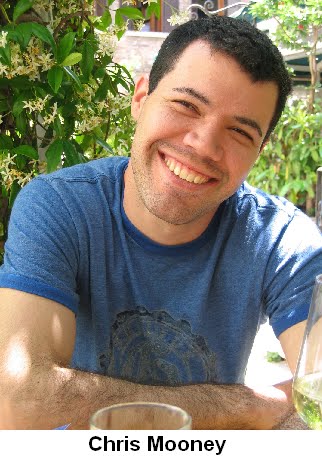
Remember Chris Mooney?
Chris Mooney has achieved some remarkable goals in the past ten years or so. He's an atheist accommodationist who doesn't understand atheism or accommodation. He's a science journalist who doesn't understand science or the important elements of science journalism (it's all about
Nisbet & Mooney Reveal Their True Colors
Matthew Nisbet and Chris Mooney Video on Framing Science
Changing Minds Through Science Communication
For Once, Chris Mooney Talks Sense
The Future of Science Journalism
Science Journalism in Decline
Some scientists are astrologers, therefore science and astrology are compatible
Chris Mooney Changed His Mind
The Doctrine of Joint Belief
Chris Mooney and Sheril Kirshenbaum in Newsweek
Boring ....
The Difference between Truth and Framing
Chris Mooney vs Atheists: Part XXXIV
Chris Mooney Asks a Hard Question
The Great Accommodationist Dud
Chris is about to publish a new book called The Republican Brain: The Science of Why They Deny Science--and Reality. Like most professional writers he knows that he has to hype the book in order to get people to buy it so he's started the campaign with an article on HuffPost under their new "Science" category [Want to Understand Republicans? First Understand Evolution].
The main theme is that Republicans are genetically different from Democrats and that difference is due to evolution. No, I'm not kidding ....
Jerry Coyne says "huh?" [Chris Mooney, evolution, and politics]. Get on over to Coyne's
1. What would we do for fun if we didn't have Chris Mooney? We'd have to pick of the creationists all the time and thatgets boring.
Was Newton the Greatest Scientist Who Ever Lived?
Most of us know that Charles Darwin was the greatest scientist who ever lived but one still finds the occasional misguided physicist/mathematician who thinks that the honor should go to an eighteenth century Englishman named Isaac Newton (1642-1727) [Top Five Dead Scientists] [Westminster Abbey: Darwin vs Newton] [Books by Charles Darwin] [Why I'm Not a Darwinist].
Now we have more direct evidence.1 The Israel National Library has just put a pile of Newton's writings on line [Israel National Library uploads trove of Newton's theological tracts ]. We get to see direct example of how Newton thinks like a scientist.
My favorite is Newton's predictions about when the apocalypse will take place. He starts his calculation with the crowing of Charlemagne as Holy Roman Emperor in 800 AD and goes downhill from there [Newton on the date 2060 (early 18th century)].
By way of contrast, the real greatest scientist who ever lived was a non-believer who never would have treated the Bible as a scientific authority.
Now we have more direct evidence.1 The Israel National Library has just put a pile of Newton's writings on line [Israel National Library uploads trove of Newton's theological tracts ]. We get to see direct example of how Newton thinks like a scientist.
My favorite is Newton's predictions about when the apocalypse will take place. He starts his calculation with the crowing of Charlemagne as Holy Roman Emperor in 800 AD and goes downhill from there [Newton on the date 2060 (early 18th century)].
In the instance displayed on this manuscript folio, Newton calculates a tentative date using the 1260 days (taken to be years) from Daniel in part to counter the claims of some of his contemporaries, who claimed that the end would come in the seventeenth or eighteenth century. Newton stood apart from contemporary interpreters who were predicting the imminent restoration of the Jews, the fall of the Catholic Church and the Second Coming of Christ. Nevertheless, Newton’s own fervent belief in these prophetic events is not in doubt. The abbreviation “A.C.” stands for Anno Christi (“the year of Christ”).There's lots more where this came from but I don't want to embarrass the Newton supporters any further.So then the time times and half a time are 42 months or 1260 days or three years and an half, reckoning twelve months to a year and 30 days to a month as was done in the Calendar of the primitive year. And the days of short lived Beasts being put for the years of lived [sic] kingdoms, the period of 1260 days, if dated from the complete conquest of the three kings A.C. 800, will end A.C. 2060. It may end later, but I see no reason for its ending sooner. This I mention not to assert when the time of the end shall be, but to put a stop to the rash conjectures of fanciful men who are frequently predicting the time of the end, and by doing so bring the sacred prophesies into discredit as often as their predictions fail. Christ comes as a thief in the night, and it is not for us to know the times and seasons which God hath put into his own breast.
By way of contrast, the real greatest scientist who ever lived was a non-believer who never would have treated the Bible as a scientific authority.
1. The information isn't new. It's just that we can now see for ourselves that Isaac Newton was remarkably unscientific in most of his writings.
P.S. Some losers are going to argue that Newton was still the greatest scientist and we should ignore the fact that his religious beliefs made him write many stupid anti-science treatises. That's like saying that Young Earth Creationists (like Newton) can be good scientists even though they believe the Earth is only 6000 years old.
Wednesday, February 8, 2012
The Mysterious Epigenome
Tom Woodward is the founder of the C.S. Lewis Society and the apologetics.org website. He has written a books (with James Gills) called The Mysterious Epigenome: What Lies Beyond DNA. You can tell from the title that this is another "evolution revolution" book capitalizing on the re-invention of a new word that means everything—and nothing.
Woodward kindly posted an article on apologetics.org that helps us decide whether this is a book worth reading.
That's pretty much all you need to know but if you areThe Avalanche
God’s love—a vast oceanic expanse? An aggressive love, “lavished” on mankind? Coming at us like an avalanche?
These ideas came to Dr. James Gills and me as we were working on our book The Mysterious Epigenome: What Lies Beyond DNA. As we tweaked the final manuscript, we were haunted over and over by a powerful, pivotal thought. As scientists continue pulling back curtain after curtain that had previously shrouded the chemical master-codes that control our DNA system (that is, the multiple integrated layers of our epigenetic “computer codes”), they were also revealing something in the realm of spirit. They had opened up a new kind of vista on the greatness of the Creator’s overwhelming intelligence—his boundless genius--which is placed on display in this bizarre biochemical landscape. The more we thought about and discussed the latest discoveries of the genome and epigenome, the more we were confronted with this sense of the cosmic architect’s “unlimited, off-the-chart wisdom” in creating and sustaining the micro-cosmos of life. At the same time, seeing the Creator’s engineering intelligence in this new light also made us ponder the striking parallel with other “overwhelming/incalculable/infinite” qualities that the Bible attributes to the Creator, such as his power, knowledge and love.
I was going to say that creationists like Woodward give the epigenome a bad name but then I realized that it isn't true. Epigenomics and epigenetics had bad names long before the creationists got wind of them.
UPDATE: Several readers noted that the DNA on the cover of the book is a left-handed helix. This doesn't inspire confidence, does it?
In case you thought that Disney World had the only fantasyland in Florida, check this out.
Michael Lynch on Evo-Devo
Michael Lynch had some cogent (and provocative, and true) words on adaptationism in his book The Origins of Genome Architectue [Michael Lynch on Adaptationism].
Here's what he has to say about evo-devo.
Consider the steady stream of recent books by authors striving to define a new field called evolutionary developmental biology (e.g., Arthur 1997; Gerhart and Kirschner 1997; Davidson 2001, 2006; Carrol et al. 2001; West-Eberhard 2003; Carrol 2005a; Kirschner and Gerhart 2005). The plots of all these books are similar: first, it is claimed that observations from developmental biology demonstrate major inadequacies in current evolutionary theory, and then a new view of evolution that eliminates many of the central shortcomings of the field is promised. Developmental biologists are correct in pointing out that evolutionary theory has not yet specifically connected genotype to phenotype's in a molecular/cell biological sense. However, extraordinary claims call for extraordinary evidence, and none of these treatises provide any formal example of the fundamental inability of evolutionary theory to explain patterns of morphological diversity. Those who argue that microevolutionary theory has made no contributions to our understanding of the evolution of form may wish to consult the substantial body of quantitative genetics literature on multivariant evolution. Such work is by no means fully satisfactory, as it is couched in terms of statistics (variances and covariances) rather than the molecular features of individual genes, but a more precise evolutionary framework for linking genes and morphology not be possible until a critical mass of generalities on the matter has emerged at the molecular, cellular and developmental levels.
For the vast majority of biologists, evolution is nothing more than natural selection. This view reduces the study of evolution to the simple documentation of differences between species, proclamation of a belief in Darwin, and concoction of a superficially reasonable tale of adopting the divergence (...). A common stance in cellular and developmental biology is that the elucidation of differences in molecular genetic pathways between two species (usually very distant species) completes the evolutionary story. No need to dig any deeper—because natural selection surely produce the end products, the population genetic details do not matter. In individual cases, this type of informal thinking may do little harm, but in the long-run it undermines the very scientific basis of with the evolutionary biology.
There are two fundamental issues here. First, the notion that interspecific differences at the molecular level reveal the mechanism of evolution ignores the fundamental distinction between the outcome of evolution and the events that lead to such changes. For example, although most animal developmental biologists argue that it was shocking to discover that the development of all animals is based on modifications of the same sets of ancient genes, many evolutionary biologists regard this view with some surprise. It is, of course, easy to criticize based on 20/20 hindsight, but we have known for decades that all eukaryotes share most of the same genes for transcription, translation, replication, nutrient uptake, core metabolism, cytoskeletal structure, and so forth. Why would we expect anything different for development? Although knowing that HOX genes play a central role in the development of all animals provides insights into the genetic scaffold from which body plans are built, it does not advance our knowledge of the evolutionary process much beyond noting that all vertebrates share a heritage of calcified skeletons. It need not even tell us that such genes were involved in the initial stages of differentiation (Alonso and Wilkins 2005). A vast chasm of stepwise (and partially overlapping) changes may separate today's products of evolution, and understanding those steps is what distinguishes evolutionary biology from comparative biology.
Michael Lynch on Adaptationism
I've been studying Michael Lynch's book The origins of Genome Architecture. It's a marvelous book, I wish everyone interested in evolution could read it and understand it.The last chapter is very interesting. Lynch talks about the importance of understanding modern population genetics.
... I will comment on the current state of affairs in evolutionary biology, particularly the perception of softness in the field that has been encouraged by the propagation of evolutionary ideas by those with few intentions of being confined by the constraints of prior knowledge.He also talks about adaptationism/panselectionism and about evolutionary-developmental biology. I'll get to evo-devo in another post [Michael Lynch on Evo-Devo] but here are some choice words about adapationism.
Despite the tremendous theoretical and physical resources now available, the field of evolutionary biology continues to be widely perceived as a soft science. Here I am referring not to the problems associated with those pushing the view that life was created by an intelligent designer, but to a more significant internal issue: a subset of academics who consider themselves strong advocates of evolution but who see no compelling reason to probe the substantial knowledge base of the field. Although this is a heavy charge, it is easy to document. For example, in his 2001 presidential address to the Society for the Study of Evolution, Nick Barton presented a survey that demonstrated that about half of the recent literature devoted to evolutionary issues is far removed from mainstream evolutionary biology.I agree with everything Lynch writes except that I have a pretty good idea what alternative mechanisms Gould proposed.
With the possible exception of behavior, evolutionary biology is treated unlike any other science. Philosophers, sociologists, and ethicists expound on the central role of evolutionary theory in understanding our place in the world. Physicists excited about biocomplexity and computer scientists enamored with genetic algorithms promise a bold new understanding of evolution, and similar claims are made in the emerging field of evolutionary psychology (and its derivatives in political science, economics, and even the humanities). Numerous popularizers of evolution, some with careers focused on defending the teaching of evolution in public schools, are entirely satisfied that a blind adherence to the Darwinian concept of natural selection is a license for such activities. A commonality among all these groups is the near-absence of an appreciation of the most fundamental principles of evolution. Unfortunately, this list extends deep within the life sciences.
....
... the uncritical acceptance of natural selection as an explanatory force for all aspects of biodiversity (without any direct evidence) is not much different than invoking an intelligent designer (without any direct evidence). True, we have actually seen natural selection in action in a number of well-documented cases of phenotypic evolution (Endler 1986; Kingsolver et al. 2001), but it is a leap to assume that selection accounts for all evolutionary change, particularly at the molecular and cellular levels. The blind worship of natural selection is not evolutionary biology. It is arguably not even science. Natural selection is just one of several evolutionary mechanisms, and the failure to realize this is probably the most significant impediment to a fruitful integration of evolutionary theory with molecular, cellular, and developmental biology.
It should be emphasized here that the sins of panselectionism are by no means restricted to developmental biology, but simply follow the tradition embraced by many areas of evolutionary biology itself, including paleontology and evolutionary ecology (as cogently articulated by Gould and Lewontin in 1979). The vast majority of evolutionary biologists studying morphological, physiological, and or behavioral traits almost always interpret the results in terms of adaptive mechanisms, and they are so convinced of the validity of this approach that virtually no attention is given to the null hypothesis of neutral evolution, despite the availability of methods to do so (Lande 1976; Lynch and Hill 1986; Lynch 1994). For example, in a substantial series of books addressed to the general public, Dawkins (e,g., 1976, 1986, 1996, 2004) has deftly explained a bewildering array of observations in terms of hypothetical selection scenarios. Dawkins's effort to spread the gospel of the awesome power of natural selection has been quite successful, but it has come at the expense of reference to any other mechanisms, and because more people have probably read Dawkins than Darwin, his words have in some ways been profoundly misleading. To his credit, Gould, who is also widely read by the general public, frequently railed against adaptive storytelling, but it can be difficult to understand what alternative mechanisms of evolution Gould had in mind.
Subscribe to:
Posts (Atom)