There are several required steps in constructing phylogenetic trees from sequence data. The first step is to align the sequences so you can make direct comparisons. It used to be the case that multiple sequence alignments had to be checked manually because none of the available computer programs were as good as an experienced scientist. That hasn't changed. What's changed is that the data sets have become so large and complicated that nobody wants to even look at the sequence alignments to see if they can be improved.
Drew et al. (2013) suggest that sequence alignments should be made available.
Until recently, uploading sequences to GenBank (or EMBL) was generally considered sufficient to ensure reproducibility of phylogenetic studies using DNA sequence data. Increasingly, however, the systematics community is realizing that archiving raw DNA sequences is not adequate, and that the underlying alignments of DNA sequences as well as the resulting phylogenetic trees are pivotal for reproducibility, comparative purposes, meta-analyses, and ultimately synthesis. Indeed, there has been a growing clamor for journals to adopt and enforce more rigorous data archiving practices across diverse disciplines [4]–[8]. As a result, about 35 evolutionary journals [5],[9] have adopted policies to encourage or require authors to upload alignments, phylogenetic trees, and other files requisite for study reproducibility [5] to TreeBASE (http://treebase.org/) and/or other public repositories such as Dryad (http://datadryad.org). Unfortunately, enforcement of such data deposition policies is generally lax, and most journals in systematics and evolution still do not require DNA sequence alignment or tree deposition. As a result, the alignments and trees underlying most published papers in systematics/phylogenetics and evolutionary biology remain inaccessible to the scientific community at large [8],[10].
I sympathize with the goal but I doubt that it can be achieved. I strongly suspect that many scientists don't even bother to produce sequence alignments. They just feed the electronic data directly into their tree-making algorithm.
I wonder how many anomalies could be resolved if they just looked at the alignments? Would they even know if bad sequence data was being used for one or two species in their alignment?
Drew, B.T., Gazis, R., Cabezas, P., Swithers, K.S., Deng, J., Rodriguez, R., Katz, L.A., Crandall, K.A., Hibbett, D.S., and Soltis, D.E. (2013) Lost Branches on the Tree of Life. PLoS Biol 11(9): e1001636. [doi: 10.1371/journal.pbio.1001636]
David Klinghoffer wonders why I'm not criticizing Stephen Myer's new book Darwin's Doubt [see On Darwin's Doubt, Still Waiting to Hear from Big Shots in the Darwin Brigade].
Where is Jerry Coyne in this debate? Where is Dawkins? Even PZ Myers? Or Lawrence Moran, who promised "I'm planning to read [Darwin's Doubt] as soon as I can get a hold of a copy -- probably sometime in August in Canada." (I'm still puzzled by that one. The book was published in June in Canada as well.) It would seem noble for the generals to go into battle alongside the ordinary foot soldiers, putting themselves at risk as well, instead of hanging back at a safe distance.
I preordered the book three months ago and received my copy from Amazon.ca on August 1st. I've been busy with other things for most of the month so I've only turned my attention to the book in the past few days.
David Klinghoffer probably thinks that reviewing another creationist book is my highest priority. That's not the case. In fact, I never promised to review it and after reading it, I never will. There are plenty of others who know more about the subject and some of them are taking the book apart, chapter by chapter [Slaying Meyer’s Hopeless Monster]. If you want details, you can do no better than Darwin’s Doubt – A Review on Skeptic Ink.
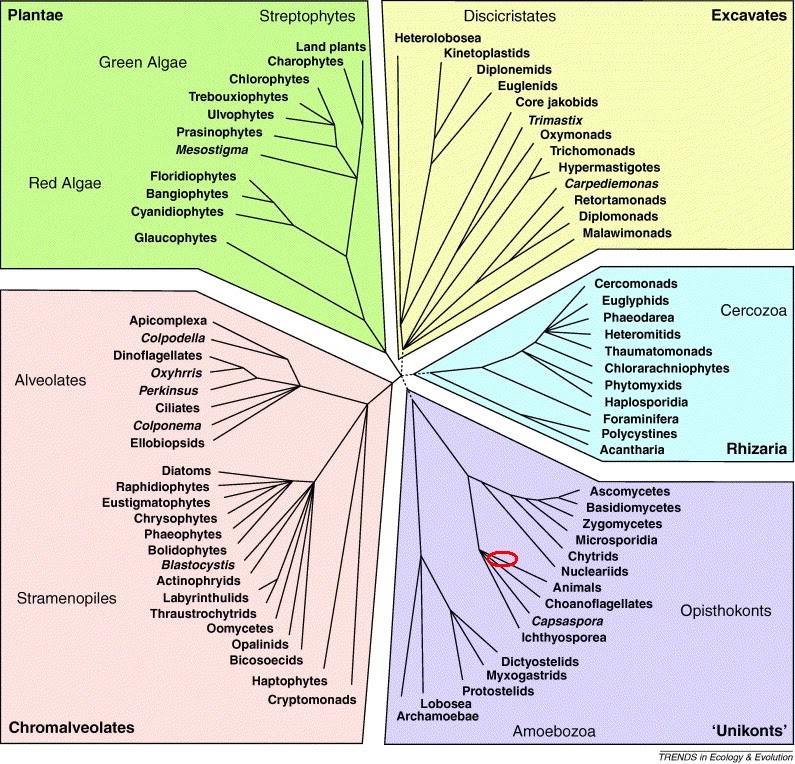
For those of you who want a brief summary, I can do no better that point you to the tree of eukaryotes on the left (Keeling et al., 2005). It summarizes tons of molecular data showing the relationships of various eukaryotes. The tree is based on solid molecular evidence that Darwin never knew existed and that evidence is direct conformation of evolution, properly defined. It represents the fixation of nearly neutral alleles by random genetic drift. Of course, you have to read very carefully to find any mention of modern evolutionary theory in Meyer's book—he prefers to focus his attack on mutation + natural selection.
I've drawn a little red circle around the part of this tree that Stephen Meyer discusses in Darwin's Doubt. It's the evolution of animals and, in particular the early fossil evidence of multicellular animals. Most of these appear rather suddenly in the fossil record during the Cambrian (about 530 million years ago). Scientists have long been puzzled about this rapid evolution of complex animals and there are many hypotheses that attempt to account for it. In fact, there's a recent book by Douglas Erwin and James Valentine that summarizes the science behind The Cambrian Explosion. It all seems quite reasonable to me.1 I don't know exactly why complex animals evolved so rapidly but I don't see any reason to doubt the facts of evolution and I don't see any reason to propose that God must have been responsible for this little bit of the tree of life.
Myer does and that's what his book is all about.
1. I don't agree with everything in that book.
Keeling, P.J., Burger, G., Durnford, D.G., Lang, B.F., Lee, R.W., Pearlman, R.E., Roger, A.J. & Gray, M.W. (2005) The tree of eukaryotes. Trends in ecology & evolution 20:670-676. [doi: 10.1016/j.tree.2005.09.005]
After two devastating world wars, the nations of the world got together in San Francisco in 1945 to form the United Nations. The goal was to prevent further wars by pledging to resolve conflicts peaceably or, if that were not possible, to act collectively to reign in rogue nations. The fundamental idea was that no one nation could decide on its own to act as judge, jury, and executioner when it comes to making war. This applies especially to powerful nations whose self righteous attitudes often led them to believe that they could ignore the views of other nations.
The goals of the United Nations have not always been achieved. We have plenty of examples of nations acting unilaterally by going to war and many examples of groups of nations that ignored the United Nations. In spite of these examples, most nations still profess allegiance to the principles that led to the founding of the United nations.
Here's Chapter 1 of the Charter of the United Nations.
Article 1
The Purposes of the United Nations are:
- To maintain international peace and security, and to that end: to take effective collective measures for the prevention and removal of threats to the peace, and for the suppression of acts of aggression or other breaches of the peace, and to bring about by peaceful means, and in conformity with the principles of justice and international law, adjustment or settlement of international disputes or situations which might lead to a breach of the peace;
- To develop friendly relations among nations based on respect for the principle of equal rights and self-determination of peoples, and to take other appropriate measures to strengthen universal peace;
- To achieve international co-operation in solving international problems of an economic, social, cultural, or humanitarian character, and in promoting and encouraging respect for human rights and for fundamental freedoms for all without distinction as to race, sex, language, or religion; and
- To be a centre for harmonizing the actions of nations in the attainment of these common ends.
Article 2
The Organization and its Members, in pursuit of the Purposes stated in Article 1, shall act in accordance with the following Principles.
- The Organization is based on the principle of the sovereign equality of all its Members.
- All Members, in order to ensure to all of them the rights and benefits resulting from membership, shall fulfill in good faith the obligations assumed by them in accordance with the present Charter.
- All Members shall settle their international disputes by peaceful means in such a manner that international peace and security, and justice, are not endangered.
- All Members shall refrain in their international relations from the threat or use of force against the territorial integrity or political independence of any state, or in any other manner inconsistent with the Purposes of the United Nations.
- All Members shall give the United Nations every assistance in any action it takes in accordance with the present Charter, and shall refrain from giving assistance to any state against which the United Nations is taking preventive or enforcement action.
- The Organization shall ensure that states which are not Members of the United Nations act in accordance with these Principles so far as may be necessary for the maintenance of international peace and security.
- Nothing contained in the present Charter shall authorize the United Nations to intervene in matters which are essentially within the domestic jurisdiction of any state or shall require the Members to submit such matters to settlement under the present Charter; but this principle shall not prejudice the application of enforcement measures under Chapter Vll.
Today we are dealing with the possibility that the most powerful nation in the world will attack a much weaker nation in spite of the opposition of many other nations, especially important permanent members of the Security Council. No peaceful resolutions are being explored and very few politicians in that powerful nation are expressing concern that they are ignoring the United Nations. All the rhetoric from that nation seems to be based on the idea that their leaders are judge, jury, and executioner when it comes to policing weaker, more vulnerable, nations. Most of those politicians do not see a problem with bombing another nation in order to punish it for a wrongdoing. Violence and war are viable options and, in this case, the first choice.
To those of us who live in other countries, that is not the kind of behavior one would like to see in the most powerful nation in the world.
I think it's about time that the United States of American quit the United Nations since it clearly has no intention of living up to its commitment to peaceful resolution of conflicts and collective action in cooperation with other nations.
The latest issue of Carnival of Evolution is hosted by Adam Benton, an undergraduate at the University of Liverpool. He's studying evolutionary anthropology. Adam blogs at Evoanth. Read: Carnival of Evolution: Eclectic September edition.
Step right up ladies and gentlemen, here for one month only under the big top is the one, the only, the carnival of evolution. For your delectable delight we have a range of articles, covering everything from bacterial evolution to Neanderthal hearing to T. rex‘s eating habits.
As someone who spends a lot of time focusing on human evolution it can be rather easy to get tunnel vision and miss all of this excellent writing on non-evoanth subjects. I’ve thoroughly enjoyed being given a taste of the world outside my field. I only wish there were some way to get people to send me these stories every month.
But before I start trying to contract out my science reading, I better get round to the reason we’re all here. So without much further ado: Welcome to the September edition of the Carnival of Evolution!
This month's edition highlights the people who SUBMITTED articles as opposed to those who wrote them. This is a reminder that anyone can submit at article—it's not just authors who submit their own works.
If you want to host a Carnival of Evolution please contact Bjørn Østman. Bjørn is always looking for someone to host the Carnival of Evolution. He would prefer someone who has not hosted before but repeat hosts are more than welcome right now! Bjørn is threatening to name YOU as host even if you don't volunteer! Contact him at the Carnival of Evolution blog. You can send articles directly to him or you can submit your articles at Carnival of Evolution although you now have to register to post a submission. Please alert Bjørn or the upcoming host if you see an article that should be included in next month's. You don't have to be the author to nominate a post.
CoE on Facebook
CoE on Twitter
This is Orientation Week at the University of Toronto. There are 10,000 beginning first year students who are just leaning what they got themselves into. Classes start next week.
Today is "Clubs Day." It's the day when all the clubs set up booths around Hart House Circle and the students come to sign up for various activities. That's Cameron Proctor, the Vice President of the University of Toronto Secular Alliance [Facebook] at his booth. I saw his list—there were about 50 people signed up. I had to clear away a huge crowd in order to get the picture. 
I didn't count the number of religious clubs but there must have been at least a dozen. Each one had five or six people soliciting new members and each one had more inquisitive students at the tables than UTSA. I don't get it. I figure that half the students are nonblievers but I guess they aren't interested in a club for nonbelievers.
UTSA has a number of programs planned for this Fall and the members meet every second Thursday starting Sept. 28. Maybe I'll see you there?
Last week's molecule was 6-phosphogluconolactone, the first intermediate in the pentose phosphate pathway. The winner was Brian Shewchuck [Monday's Molecule #212].
Today (Wednesday, but who's counting?) we're going to continue with basic metabolism in honor of all students who are just being introduced to the wonders of introductory biochemistry. Give the common name and identify the pathway. Explain briefly why this pathway is important.
Email your answers to me at: Monday's Molecule #213. I'll hold off posting your answers for 24 hours. The first one with the correct answer wins. I will only post the names of people with mostly correct answers to avoid embarrassment. The winner will be treated to a free lunch.
There could be two winners. If the first correct answer isn't from an undergraduate student then I'll select a second winner from those undergraduates who post the correct answer. You will need to identify yourself as an undergraduate in order to win. (Put "undergraduate" at the bottom of your email message.)
Read more »
We were at a wedding in Orillia (Ontario) on the weekend with my son and his wife. On the way home we took the long route and stopped at the Creemore Union Cemetery in Creemore, Ontario. The town is known mainly for its beer (Creemore Springs Brewery) but we were looking for ancestors.
James Hood was born on April 6, 1775 in Kelso, Scotland but his family moved to the Glascow area a few years later. His father was a Calton weaver and so was James. The recession following the end of the Napoleonic Wars meant that the weavers could no longer make a decent living and the British government encouraged them to emigrate to Canada by offering free passage and free land.
James and his family arrived in Canada on the "Prompt" in 1820. They settled originally in the area around Perth, Ontario. My wife, Leslie (neé Rodger) descends from James' son William whose family remained in Perth. James Hood and many of his other children moved to the Creemore area in 1830 and that's where he died on July 30, 1859.
James Hood is my wife's great, great, great, great, grandfather (and the great5 grandfather of Gordon and Jane). He is also the great, great, great grandfather of Mitt Romney [see A Mormon Tale].