Thursday, September 28, 2006

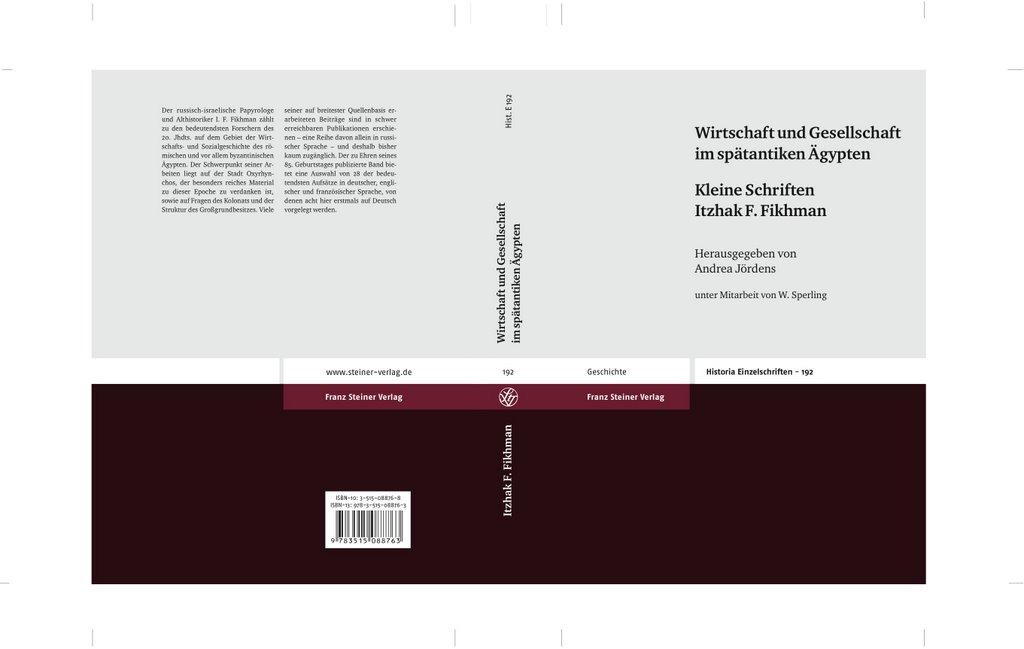
Wirtschaft und Gesellschaft im spätantiken Ägypten. Kleine Schriften (Collected Papers of I.F. Fikhman)


Wirtschaft und Gesellschaft
im spätantiken Ägypten
Kleine Schriften Itzhak F. Fikhman,
Hrg. von Andrea Jördens

Der russisch-israelische Papyrologe
und Althistoriker I. F. Fikhman zählt
zu den bedeutendsten Forschern des
20. Jhdts. auf dem Gebiet der Wirtschafts-
und Sozialgeschichte des römischen
und vor allem byzantinischen
Ägypten. Der Schwerpunkt seiner Arbeiten
liegt auf der Stadt Oxyrhynchos,
der besonders reiches Material
zu dieser Epoche zu verdanken ist,
sowie auf Fragen des Kolonats und der
Struktur des Großgrundbesitzes. Viele
seiner auf breitester Quellenbasis erarbeiteten
Beiträge sind in schwer
erreichbaren Publikationen erschienen
– eine Reihe davon allein in russischer
Sprache – und deshalb bisher
kaum zugänglich. Der zu Ehren seines
85. Geburtstages publizierte Band bietet
eine Auswahl von 28 der bedeutendsten
Aufsätze in deutscher, englischer
und französischer Sprache, von
denen acht hier erstmals auf Deutsch
vorgelegt werden.

Source: Papy-L 9/26/06

Sunday, September 24, 2006

SBL Annual Meeting: Papyrology and Early Christian Backgrounds Sessions


Papyrology and Early Christian Backgrounds
11/18/2006
4:00 PM to 6:30 PM
Room: 301 - CC
David Martinez, University of Chicago, Presiding

Giovanni Battista Bazzana, University of Milan
Waiting for the Kingdom: A Papyrological Analysis of the Lord's Prayer (25 min)

Roberta Mazza, Università di Bologna
The Papyrological Commentary of the Gospel of Mark: Words and Themes Relating to Economic and Social History. (25 min)

Don Barker, Macquarie University, Sydney
Oxyrhynchus Papyri XV 1780 (25 min)

Peter M. Head, Tyndale House
Named Letter Carriers in the Documentary Papyri (25 min)

Lincoln Blumell, University of Toronto
Scriptural Allusions and Reminiscences in Private Christian Letters from Oxyrhynchus (25 min)

S19-68
Papyrology and Early Christian Backgrounds
Joint Session With: Papyrology and Early Christian Backgrounds, New Testament Textual Criticism
11/19/2006
1:00 PM to 3:30 PM
Room: 146B - CC
Theme: Panel discussion on Larry W. Hurtado, The Earliest Christian Artifacts: Manuscripts and Christian Origins (Eerdmans, forthcoming 2006).

David Martinez, University of Chicago, Presiding

Michael Holmes, Bethel University, Panelist (20 min)
AnneMarie Luijendijk, Princeton University, Panelist (20 min)
Bart Ehrman, University of North Carolina - Chapel Hill, Panelist (20 min)
Larry Hurtado, University of Edinburgh, Respondent (20 min)
Discussion (50 min)

Ancient Society 35 (2005)


1 - 17
Real Slave Prices and the Relative Cost of Slave Labor in the Greco-Roman World
SCHEIDEL, W.

19 - 57
The Parallelogram and the Pinecone Geographical Definition of Shapes in Greek and Roman Geography on the Evidence of Strabo
DUECK, Daniela

59 - 77
Tramandere τὸ σαφές: Note in margine a Thuc. I 9.2
CUSCUNÀ, Cristina

79 - 100
Astenia del mito e dinamismo della gnome
La crisi dell'Hellenikon in due discorsi de La guerra del Peloponneso
CASERTA, Cristiana

101 - 117
Un usage fort controversè: La parentè dans le langage diplomatique de l'Èpoque hellènistique
CURTY, O.

119 - 128
A Letter from Zenon to Kleon: A New Date for P. Zen. Pestm. Suppl. B
VAN BEEK, B.
Abstract :
The present article offers a new reading for P. Zen. Pestm. Suppl. B, a papyrus text in which Zenon complains to Kleon about uninundated land. The date given in the text appears to have been a double date, though only partially preserved. The new dating fits the chronology of the Zenon archive better.

129 - 134
The Archive of Euphron
CLARYSSE, W.
Abstract :
Reedition of a papyrus letter belonging to an archive from the Cynopolite nome in Middle Egypt and dating from the second century BC. The writer of the letter is called Pasinous, a rare Greek name typical of Crete.

135 - 165
Goddess of Love and Mistress of the Sea: Notes on a Hellenistic Hymn to Arsinoe-Aphrodite (P. Lit. Goodsp. 2, I-IV)
BARBANTANI, Silvia
Abstract :
This article analyses one of the hexametric poems copied on a 2nd-century AD papyrus, possibly from Hermupolis, P. Lit. Goodspeed 2: a Hellenistic hymn to Aphrodite celebrated as a patroness of the sea and of wedded love. This portrayal of the goddess perfectly fits with Ptolemaic royal propaganda in the 3rd century BC. The address to Ἁρσινόα Πτολεμα(ὶ) (II 5) reveals that the goddess is here worshipped as a divine image of a queen Arsinoe, most probably Arsinoe II Philadelphos, who had strong links with key figures of the Ptolemaic navy. The hymn is compared with contemporary Alexandrian poetry, such as the epigrams of the Milan papyrus P. Mil. Vogl. VIII 309. Some hypotheses are also presented on the context of the composition and the performance of the hymn (a Cypriot cult of Arsinoe Philadelphos?).

167 - 173
Prodigies at Privernum: A Note on Cicero, div. I 97
SANTANGELO, F.

175 - 195
Herod the Great and the Copper Mines of Cyprus
HAUBEN, H.

197 - 216
Collegia in the Province of Egypt in the First Century AD
ARNAOUTOGLOU, I.
Abstract :
ln this article I explore the apparent discrepancy between the restrictive statutory Roman legislation on collegia and the documentation on associations in 1st-century Egypt. After exploration of the legal background, I examine the testimony of Philo, ln Flaccum 4, which reveals that the dissolution of hetaireiai and synodoi is not part of an empire-wide ban, but is firmly embedded in the history of Alexandria and in the urge of its prefect A. Flaccus to re-establish law and order. The second testimony providing the imposition of a fine on people taking part in associations, Gnomon of the ldios Logos §108, is so fragmentary as to allow only speculation about its context. It could preserve a clause either from A. Flaccusí restrictions or from a tax regulation. The investigation suggests that the discrepancy between the literary tradition of a general ban and the documentary evidence on collegia is probably superficial, and it can be reconciled, if we reconsider the nature and the extent of the prohibition imposed by A. Flaccus, as a local and temporary police measure aiming to dissolve the nuclei of opposition and anti-Roman feeling in early 1st-century Alexandria.

217 - 250
Apollo and the Emperors (II): The Evolution of the Imperial Cult at Sagalassos
TALLOEN, P. & WAELKENS, M.

ZPE 157 (2006)


INHALTSVERZEICHNIS ZPE 157 (2006)

Ast, R.,
Notes on BGU XIX 162–164

Barker, D.,
Epitaph of Proklos 105–106

Bartels, J.,
Lateinische Grabinschriften aus Philippi: Corrigenda 199–212

Battistoni, F.,
The Ancient pinakes from Tauromenion. Some New Readings 169–180

Bingen, J.,
Ϲπουδαϲτήϲ - ἐπιϲπουδαϲτήϲ 159–161

Brun, P. – Couvenhes, J.-C.,
Des chiliarques à Athènes au milieu du IVe siècle? La datation de B. Petrakos, ὁ δῆμος τοῦ ῾Ραμνοῦντες ΙΙ. οἱ ἐπιγραφές 1 107–115

Camodeca, G.,
Cura secunda della tabula cerata londinese con la compravendita della puella Fortunata 225–230

Ciongradi, C.,
Ein neuer Altar für Silvanus aus Dacia Porolissensis. Studien über die arae in Dakien 213–224

Couvenhes, J.-C. – Brun, P.,
Des chiliarques à Athènes au milieu du IVe siècle? La datation de B. Petrakos, ὁ δῆμος τοῦ ῾Ραμνοῦντες ΙΙ. οἱ ἐπιγραφές, n° 1 107–115

Crislip, A.,
A Coptic Request for Materia Medica 165–167

Dana, D.,
Les noms de facture thrace dans LGPN IV: les noms fantômes et d’autres corrections 127–142

Daris, S.,
I Quartieri di Arsinoe: Addenda 143–146

Dettori, E.,
Γάμορος: una occorrenza “fantasma” 41–42

Diaz Ariño, B., C.
Memmius, gobernador de la Hispania Ulterior 231–236

Durbec, Y.,
Callimaque, Aitia fr. 260 A SH: une nouvelle interprétation 43–45

Duttenhöfer, R.,
Korrekturen zu Ostraka aus Elephantine/Syene II 147–158

Eck, W. – Pangerl, A.,
Zur Herstellung der diplomata militaria: Tinte auf einem Diplom des Titus für Noricum 181–184

Eck, W. – Pangerl, A.,
Eine Konstitution für die Truppen von Syria Palaestina aus dem Jahr 158 185–191

Gardeñes Santiago, M. – Santiago Álvarez, R.-A.,
Algunas observaciones a la “Lettre d’Apatorios à Léanax” 57–69

Geissen, A. – Weber, M.,
Untersuchungen zu den ägyptischen Nomenprägungen VII 277–304

Granino Cecere, M. G.,
Dalle sponde del Reno a quelle dell’Aniene: marinai e navigazione fluviale 237–246

Gronewald, M., Kallimachos, Aitia fr. 64,10 Pf. 46

Grünewald, M. – Richter, A.,
Zeugen Caesars schwerster Schlacht? Beschriftete andalusische Schleuderbleie aus der Zeit des Zweiten Punischen Krieges und der Kampagne von Munda 261–269

Henry, W. B.,
Archilochus, P. Oxy. 4708 fr. 1.18–21 14

Huß, W., Zur
Invasion Ptolemaios’ VIII. Soters II. in Ägypten (103 v. Chr.) 168

Kapranos, N. – Martínez Fernández, Á. – Tsatsaki, N.,
Una inscripción inédita de Chamalevri, Creta 87–94

Łajtar, A. – van der Vliet, J.,
Rome – Meroe – Berlin. The Southernmost Latin Inscription Rediscovered (CIL III 83) 193–198

Lehoux, D.,
Rethinking Parapegmata: The Puteoli Fragment 95–104

Lendon, J. E.,
Contubernalis, Commanipularis, and Commilito in Roman Soldiers’ Epigraphy: Drawing the Distinction 270–276

Ma, J.,
A Gilt Statue for Konon at Erythrai? 124–126

Martínez Fernández, Á. – Tsatsaki, N. – Kapranos, N.,
Una inscripción inédita de Chamalevri, Creta 87–94

Mayer, P.,
Krieg aus Versehen? Zur Funktion und Aussage der Telephos-Geschichte im neuen Archilochos (P. Oxy. 4708, fr. 1) 15–18

Nünlist, R.,
A Neglected testimonium on the Homeric Book-Division 47–49

Pangerl, A. – Eck, W.,
Zur Herstellung der diplomata militaria: Tinte auf einem Diplom des Titus für Noricum 181–184

Pangerl, A. – Eck, W.,
Eine Konstitution für die Truppen von Syria Palaestina aus dem Jahr 158 185–191

Perysinakis, I. N.,
Κόσμον or κόμπον? A Note on Simonides’ Elegy on Plataea, fr. 11.23 W2 19–21

Primavesi, O.,
Empedokles in Florentiner Aristoteles-Scholien 27–40

Rawles, R.,
Notes on the Interpretation of the “New Sappho” 1–7

Rawles, R.,
Musical Notes on the New Anonymous Lyric Poem from Köln 8–13

Rhodes, P. J.,
Milesian Stephanephoroi: Applying Cavaignac Correctly 116

Richter, A. – Grünewald, M.,
Zeugen Caesars schwerster Schlacht? Beschriftete andalusische Schleuderbleie aus der Zeit des Zweiten Punischen Krieges und der Kampagne von Munda 261–269

Ruscu, L.,
Actia Nicopolis 247–255

Rusten, J.,
The Four “New Lenaean Victors” of 428–5 B.C. (and the Date of the First Lenaean Comedy) Reconsidered 22–26

Santiago Álvarez, R.-A. – Gardeñes Santiago, M.,
Algunas observaciones a la “Lettre d’Apatorios à Léanax” 57–69

Sarnowski, T.,
The Phantom Squadron of the Ravennate Fleet on the Black Sea in the 1st Century AD 256–260

Spanoudakis, K.,
Notes on Nicander’s Theriaca 50–56

Summa, D.,
Attori e coreghi in Attica: iscrizioni dal teatro di Thorikos 77–86

Thomas, O.,
Ephebes Reunited: A New Edition of IG II2 1967 71–76

Tsatsaki, N. – Martínez Fernández, Á. – Kapranos, N.,
Una inscripción inédita de Chamalevri, Creta 87–94

van der Vliet, J. – Łajtar, A.,
Rome – Meroe – Berlin. The Southernmost Latin Inscription Rediscovered (CIL III 83) 193–198

Walton, C.,
Foreign Judges in the Hellenistic Cyclades 117–123

Weber, M. – Geissen, A.,
Untersuchungen zu den ägyptischen Nomenprägungen VII 277–304

Source: Uni-Köln Institut für Altertumskunde page
Saturday, September 23, 2006

Aegyptus LXXXII (2005)


Source: Archaeogate, Papirologia
SOMMARIO

S. CURTO,
Further remarks on the origin of Egyptian writing

F. CREVATIN,
Questioni minori di lingua e cultura egiziana

S. BOSTICCO, G. ROSATI,
Il sarcofago di Amenemhet-seneb a Firenze

E. CRISCI,
"Ratio delendi". Pratiche di riscrittura nel mondo antico

P. ORSINI,
Edizioni dell'Odissea di Omero su codice: il caso P.Ant. III 169

A. STRAMAGLIA,
PSI 151 + P.Mil.Vogliano 260 (LDAB 5254):δεύτεραι φροντίδες

S. COSTANZA,
P.Vindob. G 2859 verso: rapporti e connessioni con la tradizione palmomantica

A. SOFIA,
Influssi egizi in Sicilia e in Magna Grecia. Testimonianze nella commedia dorica, nel mimo e nella farsa fliacica

T. BRACCINI,
L'oasi di Soterico

G. NACHTERGAEL,
Quelques inscriptions grecques sur des intailles magiques

R. PINTAUDI,
Favorino, non Cratino

G. NACHTERGAEL, R. PINTAUDI,
Une pétition au préfet d'Égypte (P. Saqqara inv 539 B)

M. PICCOLO,
Osservazioni ad alcuni papiri dell'archivio dì Tryphon

C. BALCONI,
Rileggendo una ricevuta di laografia (SB XIV 11287)

A. DELATTRE,
L'apophtegme de Grégoire de Nysse au Deir Abou Tennis

E. LUCCHESI,
L'homélie De nativitate de Damien d' Alexandrie: un témoin copte du Monastère Blanc

N.M. HIGH,
Textilkunde und Papyri. Ein Beitrag zur koptischen Kleiderliste CPR XII 2

Testi recentemente pubblicati

RECENSIONI:
Les textes de la pyramide de Pépy I, Mission Archéologique Française de Saqqâra sous la direction de JEAN LECLANT, Mémoires de l'IFAO 118/1-2, Le Caire 2001. Vol. I: C. BERGER-EL NAGGAR, J. LECLANT, B. MATHIEU, I. PIERRE-CROISIAU, Description et analyse; Vol. II: I. PIERRE-CROISIAU, Fac-similés (S. CERUTI)

P. PIACENTINI, C. ORSENIGO, La Valle dei Re riscoperta. I giornali di scavo di Victor Loret (1898-1899) e altri inediti, Le vetrine del sapere 1, Milano 2004 (P. VERNUS)

Prosopographia Ptolemaica, vol. X, Foreign Ethnics in Hellenistic Egypt, by CSABA A. LA'DA (Studia Hellenistica 38), Leuven 2002 (O.MONTEVECCHI,, G. CASANOVA)

URI YIFTACH-FIRANKO, Marriage and Marital Arrangement: a History of the Greek Marriage Document in Egypt. 4 Century BCE-4 Century CE (Münchener Beiträge zur Papyrusforschung und Antiken Rechtsgeschichte, 93. Heft), München 2003 (M. AMELOTTI)

ARISTIDE CALDERINI, Dizionario dei nomi geografici e topografici dell'Egitto greco-romano, a cura di SERGIO DARIS, supplemento 1°, Milano 1988; supplemento 2°, Bonn 1996; supplemento 3°, Pisa 2003 (O. MONTEVECCHI)

Perspectives on Panopolis, an Egyptian Town from Alexander the Great to the Arab Conquest, ed. by A. EGBERTS, B.P. MUHS, J. VAN DER VLIET (P.L.Bat. 31), Leiden 2002 (O. MONTEVECCHI)

Tebtynis und Soknopaiu Nesos. Leben im römerzeitlichen Fajum. Akten des Internationalen Symposions vom 11. bis 13. Dezember 2003 in Sommerhausen bei Würzburg, hgb. von SANDRA LIPPERT und MAREN SCHENTULEIT, Wiesbaden 2005 (R. PINTAUDI)

Annibale Evaristo Breccia in Egitto, a cura di AHMED ABDEL FATTAH, EDDA BRESCIANI, SERGIO DONADONI, DILETTA MINUTOLI, ROSARIO PINTAUDI, FLORA SILVANO - Mostra Documentaria, a cura di D. MINUTOLI, II Cairo 2003 (G. CASANOVA)

KURT NIEDERWIMMER, Theologie des Neuen Testaments. Ein Grundriβ, Wien 2003 (HANS FÖRSTER)

ACHIM BUDDE, Die ägyptische Basilios-Anaphora (Jerusalemer Theologisches Forum, Band 7), Münster 2004 (J. HENNER)

Studi di Egittologia e di Papirologia


Source: Archaeogate, Papirologia

SOMMARIO

FRANCESCA ANGIÒ, II nuovo Posidippo (2004)

ROGER S. BAGNALL, RAFFAELLA CRIBIORE, TIMOTHY T. RENNER, A Coptic Letter from
two Women

MARCO BERGAMASCO, La διδασκαλική di PSI x 1132

STAMATIS BUSSÈS, Lista di oggetti

MARIO CAPASSO, L'intellettuale e il suo re (Filodemo, L'Adulazione, PHerc 1675, col. v 21-32)

MARIO CAPASSO, Settantanni dopo "Mr.Michigan": nuovi ritrovamenti di papiri e ostraka a Soknopaiou Nesos

SERGIO DARIS, Note per la storia dell'esercito romano in Egitto • III

DIDIER DEVAUCHELLE, Écrire le nom des jours épagomènes et du premier jour de l'an
(ODém. DelM 4-1)

GEORGES NACHTERGAEL, Trois lettres d'unefamille de Philadelphie

NATASCIA PELLÉ, A proposito di PKöln III 126, col. 11-4. Apollodoro, Sugli dèi

NATASCIA PELLÉ, Per un bilancio della fortuna di Senofonte storico e narratore in Egitto

AMARILLIS POMPEI, La funzione della Regina Madre nella investitura dei sovrani in epoca napatea

ENZO PUGLIA, Platone e l'ospite caldeo nella Storia dell'Academia di Filodemo (PHerc 1021, coll. III 39-v 19)

ENZO PUGLIA, Una lettera inedita di Theodor Gomperz a Giulio Minervini

ENZO PUGLIA, Una proposta per l'epigramma 37 A.-B. di Posidipp

Thursday, September 21, 2006

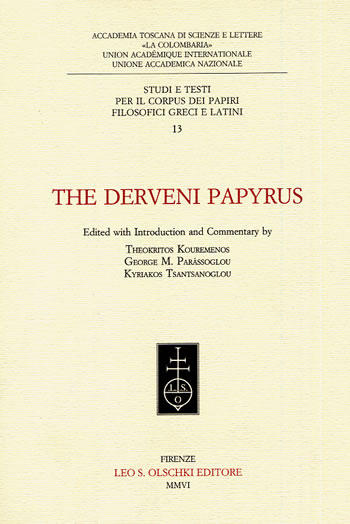
Publication: The Derveni Papyrus


Authorized editio princeps of the oldest Greek papyrus yet found.
Source: Papy-L 9/21/06
See also: R. Janko, ZPE 141, 2002, 1-62


THE DERVENI PAPYRUS
Edited with Introduction and Commentary by
Theokritos Kouremenos, George M. Parássoglou
Kyriakos Tsantsanoglou
Studi e testi per il «Corpus dei papiri filosofici greci e latini», vol. 13
2006, cm 17 x 24, xvi-310 pp. con 30 tavv. f.t. 35,00 Euro.
[ISBN 88 222 5567 4]

"The burnt scroll from Derveni (Greece) is one of last century’s most interesting find. Dating back to the 4th century
B.C., it proves to be a precious witness to the history of orphism, religion and Greek philosophical thought. This is
the first, complete and official edition of the Derveni scroll, with papyrology section, translation, comment and index
of words. The complete reproductions of the scroll, hereby published for the first time, are of extreme importance. "

from Archaeogate, Papirologia
TABLE OF CONTENTS

Presentazione
Avvertenza
Acknowledgments

Introduction
I. The find (K.Ts.)
II. The contents of the Derveni papyrus (Th.K.)
III. The quotations from Orpheus' poem (Th.K.)
IV. The contents of Orpheus' poem (Th.K.)
V. The Derveni author's cosmology (Th.K.)
VI. The Derveni author's aims (Th.K.)
VII. The Derveni author (Th.K.)

Text (K.Ts. - G.M.P.)

Translation (K.Ts. - G.M.P.)

Commentary (Th.K.)
col. II, p. 143; col. III, p. 146; col. IV, p. 148; col. V, p. 161; col. VI, p. 166; col. VII, p. 171; col. VIII, p. 174; col. IX, p. 176; col. X, p. 182; col. XI, p. 186; col. XII, p. 189; col. XIII, p. 193; col. XIV, p. 197; col. XV, p. 204; col. XVI, p. 213; col. XVII, p. 217; col. XVIII, p. 226; col. XIX, p. 229; col. XX, p. 233; col. XXI, p. 242; col. XXII, p. 253; col. XXIII, p. 256; col. XXIV, p. 260; col. XXV, p. 266; col. XXVI, p. 271.

Abbreviations and Bibliography
Index of Passages
Indices verborum et locorum
Plates (Reconstruction of the Roll: G.M.P. - K.Ts.)