Much to my embarrassment, the University of Toronto is promoting online courses, or MOOCs [Online courses for anyone, anywhere]. These courses seem to be for information only—you can't get a university credit for them.
I'm not opposed to offering free "courses" for people who don't have easy access to a university campus. In fact, I think it's a good thing. But let's make sure we distinguish between public lectures and serious education. In my opinion, if the quality of an online course is equal to the quality of a course given on campus then all that says is that the campus-based course is lousy. We should not refer to these online examples as "university courses." They should be labelled as "public lectures."
I'll have more to say about this later but today I want to return to an issue I raised before. Is it true that the "best" universities also do the best teaching? I have suggested that the answer to this question is probabyy "no" [On the Quality of Online Courses] [Is Canada Lagging Behind in Online Education?].
Read more »
Thursday, July 19, 2012
University Tuitions in Canada and the United States
The University of Toronto is the largest university in North America (70,000 students) and one of the top 20 universities in the world1 [The World University Rankings 2011-2012]. It ranks near the top among the group of very large public universities [World University Rankings].
The University of Toronto is a public university. A large percentage of its operating budget comes directly from the provincial government. In that sense, it is comparable to many of the large state schools in the United States. When we're judging ourselves,2 we use a list of nine American state schools of comparable size and quality.
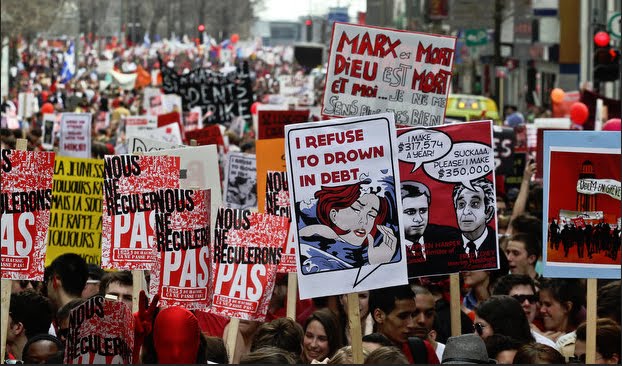
Tuition costs have been in the news in Canada recently since there have been vocal student protests in Quebec over government plans to raise tuition costs in Quebec schools. The combination of tuition and fees will increase from $2,890 per year to $4,700 per year over a five year phase-in period.
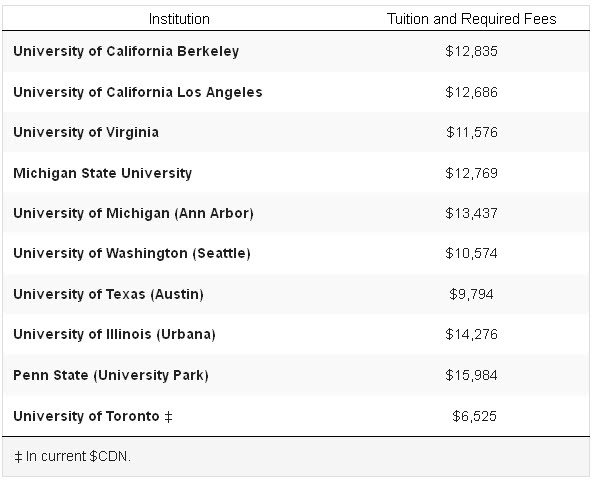
What is the average cost of tuition plus fees at the University of Toronto and how does this compare with similar American schools? President David Naylor gives us the answer on his website where he discusses the problem of student debt in Canada and the United States [Student Debt Redux].
If you're an American, consider sending your children to a Canadian university. You'll save a lot of money and there's an added bonus—we get to show them what a real "socialist" country looks like.
The University of Toronto is a public university. A large percentage of its operating budget comes directly from the provincial government. In that sense, it is comparable to many of the large state schools in the United States. When we're judging ourselves,2 we use a list of nine American state schools of comparable size and quality.
Tuition costs have been in the news in Canada recently since there have been vocal student protests in Quebec over government plans to raise tuition costs in Quebec schools. The combination of tuition and fees will increase from $2,890 per year to $4,700 per year over a five year phase-in period.
What is the average cost of tuition plus fees at the University of Toronto and how does this compare with similar American schools? President David Naylor gives us the answer on his website where he discusses the problem of student debt in Canada and the United States [Student Debt Redux].
If you're an American, consider sending your children to a Canadian university. You'll save a lot of money and there's an added bonus—we get to show them what a real "socialist" country looks like.

Note: One of the signs in the protest says, "Marx is dead, God is dead, and I don't feel so good."
1. There are many problems with these ranking but the bottom line is that the University of Toronto is a pretty good university as judged by outsiders.
2. Which we do obsessively every few months.
Wednesday, July 18, 2012
Stress and Telomere Length—Do You Believe this Study?
Healthy skepticism is an important part of science. One of the biggest differences between scientists and intelligent design creationists, for example, is that the creationists are rarely skeptical of anything they read in the scientific literature. If it appears to support their agenda, then it goes right onto the blogs without any discussion of whether it might be true or not.
Scientists, on the other hand, are often very skeptical of work that appears in the scientific literature. They treat most papers as tentative results that need to be confirmed. The most obvious flawed papers will be refuted by further work, as in the recent arsenic in DNA paper or earlier work on cold fusion. Usually, flawed papers will just be ignored and they will die a quiet death.
Read more »
Scientists, on the other hand, are often very skeptical of work that appears in the scientific literature. They treat most papers as tentative results that need to be confirmed. The most obvious flawed papers will be refuted by further work, as in the recent arsenic in DNA paper or earlier work on cold fusion. Usually, flawed papers will just be ignored and they will die a quiet death.
Read more »
Questions for Genetics Students
Rosie Redfield has published a (deliberately) provocative article on teaching genetics in the 21st century (Redfield, 2012). I disagree strongly with her premises and her conclusions but the issues are complex—too complex for a single posting.
Let's start by looking at one aspect of her proposal.
Rosie thinks that a 21st century course on genetics should focus on information that students can use later on. Here's how she would begin her new course ...
Let's start by looking at one aspect of her proposal.
Rosie thinks that a 21st century course on genetics should focus on information that students can use later on. Here's how she would begin her new course ...
Box 4 gives a suggested syllabus for a 21st century genetics course. It begins with a human focus, introducing personal genomics and our natural genetic variation. Students then learn about the underlying molecular explanations—how differences in DNA sequences arise and evolve, and how they cause differences in phenotype—followed by how genetic differences are inherited and recombined.Read more »
Tuesday, July 17, 2012
Evolution Is Purposeless and Unguided—Deal with It!
Many prominent scientists get it right when they say that evolution is purposeless and unguided. The same is true for plate tectonics, supernovas, radioactive decay, and the weather.
If you have a problem with this, read Jerry Coyne at What’s the problem with unguided evolution? and take it up with him. I'm tired of trying to convince theists and accommodationists of something that's as plain as the nose on your face.
Not to beat a dead horse (I think it’s still alive), but I vehemently oppose those evolutionists and accommodationists who won’t affirm that evolution is unguided and purposeless (in the sense of not being directed by a higher intelligence or teleological force). For to the best of our knowledge evolution, like all natural processes, is purposeless and unguided. After all, scientists have no problem saying that the melting of glaciers, the movement of tectonic plates, or the decay of atoms are processes that are unguided and purposeless.
Some beating of dead horses may be ethical, when here and there they display unexpected twitches that look like life.
Emile Zucherkandl and Linus Pauling (1965)
Eschaton 2012
Most of you missed the exciting Evolution Ottawa 2012 meeting earlier this month but, cheer up, you have another chance to visit Ottawa form Novermber 30 to December 2, 2012.
The meeting is called Eschaton 2012 where "eschaton" refers to the end of the world. That's because, as you all know by now, the world is going to end on December 21, 2012. The Mayans said so and so do a lot of modern kooks.
Here's an outline of the meeting.
Chris DiCarlo and I are teaching a course at the University of Toronto next Fall on scientific controversies and misconceptions (including evolution vs creationism). Maybe we can have a workshop on Sunday to discuss science literacy?
The meeting is called Eschaton 2012 where "eschaton" refers to the end of the world. That's because, as you all know by now, the world is going to end on December 21, 2012. The Mayans said so and so do a lot of modern kooks.
Here's an outline of the meeting.
The conference opens with a Friday night plenary session on the historical relationship between humans and our apocalypses. Saturday morning and afternoon, we have parallel tracks: 1) Talks and panels on skepticism/science/science communication (including a live recording of Ottawa Skeptics' podcast, The Reality Check) and 2) "The Immaculate Convention" - talks and panels on religion from an academic and sociological perspective. Saturday evening there will be a reception with food and drink in the early evening at the Canadian Museum of Nature (around the corner from the hotel), after which there will be a talk by PZ Myers, followed by a meet-and-greet social, with snacks, cash bar, and access to some of the galleries and exhibits. On Sunday the parallel tracks include panels and workshops on ethics, gender identity, parenting, and other exciting topics to be announced.Here's the latest list of speakers. (I changed the order somewhat from the one on the website.)
- Larry Moran
- P.Z. Myers
- Ophelia Benson
- Chris DiCarlo
- Ian Cromwell
- Natalie Reed
- Udo Schuklenk
- Eugenie Scott
- Jim Linville
- Sara Mayhew
- Jeff Shallit
- Eric MacDonald
- Ania Bula
- Heina Dadabhoy
- The Reality Check
- Annie Urban
- Allan Daoust
- Crystal Beauvais Daoust
- Anila Asghar
- Steve Tomlins
Chris DiCarlo and I are teaching a course at the University of Toronto next Fall on scientific controversies and misconceptions (including evolution vs creationism). Maybe we can have a workshop on Sunday to discuss science literacy?
H. Cuvigny, Didymoi. Une garnison romaine dans le désert Oriental d’Égypte - 2. Les textes
Hélène Cuvigny (éd.)
Didymoi. Une garnison romaine dans le désert Oriental d’Égypte - 2. Les textes
Le second volume de la publication de Didymoi rassemble le matériel inscrit : inscriptions lapidaires, ostraca (y compris figurés), petits objets (les photos des ostraca sont publiées en ligne sur le site de l’Ifao). Parfois datés, ces témoins contribuent à la compréhension des architectures et des stratigraphies de Didymoi, analysées dans le premier volume. Aux deux extrémités de l’empan chronologique, la dédicace du fort (76/77p) et la copie d’une circulaire destinée à annoncer aux garnisons du désert de Bérénice la bonne nouvelle de l’association du César Maxime au pouvoir impérial (236p). Outre les documents générés par la routine du service et du ravitaillement (journaux de poste, laissez-passer, ordres de livraison, comptes, tituli vasculaires), les lettres privées envoyées des garnisons voisines abondent en instantanés sur la vie des militaires stationnés dans les fortins du désert Oriental et sur celle des civils, qui tempéraient l’inconfort et l’ennui de cette affectation. Un marchand préfère vendre sa viande à Bérénice malgré la demande locale, un helléniste compose péniblement une lettre en latin au moyen d’un glossaire ; tel débouche une amphore pour remercier le camarade venu du fortin voisin l’aider à faire son pain; un curator praesidii a été prié par ses hommes d’écrire à un proxénète pour passer commande de sa «petite esclave, celle à soixante drachmes»; un homme félicite une nouvelle accouchée; il a, en action de grâce, allumé une lampe à Aphrodite; un cavalier s’inquiète pour un jeune chien qui l’a suivi alors qu’il s’éloignait à cheval et qui n’est pas rentré au fort. Dans les installations romaines du désert Oriental, les documents demeurés sur place – parce qu’ils ont été mis au rebut – ne sont pas les sources dont rêve l’historien. Une synthèse liminaire fait le point sur ce qu’ils apportent néanmoins à la connaissance du maillage militaire dans cette zone de transit caravanier.
•••
The second volume of the publication of Didymoi contains the inscribed material, such as inscriptions on stone, ostraca with text or images, and small objects (the photos of the ostraca are published online on the Ifao website). As they are sometimes dated, these objects contribute to the understanding of the architecture and stratigraphy of Didymoi that was published in the first volume. At the extremities of the chronological span we have the dedication of the fort (AD 76/77) and the circular letter to the garrisons of the desert of Berenike announcing the good news that Maximinus Thrax promoted his son to Caesar (AD 236). Apart from the documents generated by the military routine and the provisioning of the fort, such as postal registers, passes, orders to deliver, accounts, and inscriptions on jars, there are a great many private letters sent from neighbouring stations. These letters give us snapshots of the life of the soldiers who were stationed in the forts of the Eastern Desert and of the civilians who mitigated the boring discomfort of this service. A merchant prefers to sell his meat in Berenike in spite of local demand. A Greek speaker painstakingly writes a letter in Latin with the help of a glossary. Someone opens a jar of wine to thank a friend who has come from a neighbouring fort to help him make his bread. A curator praesidii has been asked by the men to write to a procurer to order ‘your girl who makes you sixty drachmas’. A man writes to congratulate a woman on the birth of her child, saying that he has lit a lamp to Aphrodite in gratitude. A horseman is worried about a young dog that followed his horse when he left the fort, but has not come back. In the military establishments of the Eastern Desert the documents that remain to be found have remained because they were thrown away, and are not the sources that historians dream of. Nevertheless, an introductory chapter gives a synthesis of what they do contribute to our knowledge of the military network in this zone passing caravans.
Subscribe to:
Posts (Atom)